Kuwait’s spring shamal season does not just cover everything in dust — it physically damages outdoor structures that were not designed to handle it. Every year, property owners across Kuwait discover cracked panels, warped frames, loose bolts, and shredded fabric on shade structures and metalwork that seemed perfectly fine in December. Sandstorms and shamal winds are a structural engineering challenge, not just an inconvenience. In 2026, understanding how sandstorms affect outdoor structures in Kuwait is essential for anyone planning, maintaining, or repairing shade structures, pergolas, gates, or fencing on their property. This guide covers the specific damage mechanisms that Kuwait’s sandstorm conditions create and how to design, specify, and maintain structures that survive them.
How Sandstorms Affect Outdoor Structures in Kuwait — and Why It Matters for Design
Kuwait’s shamal winds blow predominantly from the north-northwest, reaching gusts of 80–100 km/h during major spring events. These winds carry fine desert particulates that act as an abrasive medium on exposed surfaces and create dynamic pressure loading on any structure with a solid or semi-solid roof profile. Fine particles infiltrate every unsealed gap in a structure, depositing inside roof panel channels, joint connections, and drainage gutters.
The structural threat of sandstorms is compounded by Kuwait’s temperature swings — structures that expand in the daytime heat and contract at night develop small gaps at joints that progressively admit more sand with each cycle. Haddad Muzallat engineers every outdoor structure installation with Kuwait’s shamal conditions as a primary design input, not an afterthought. Explore Kuwait shade structure services designed to withstand extreme wind and sandstorm conditions.

Types of Sandstorm Damage to Kuwait Outdoor Structures
Wind Pressure Failure on Roofing Panels
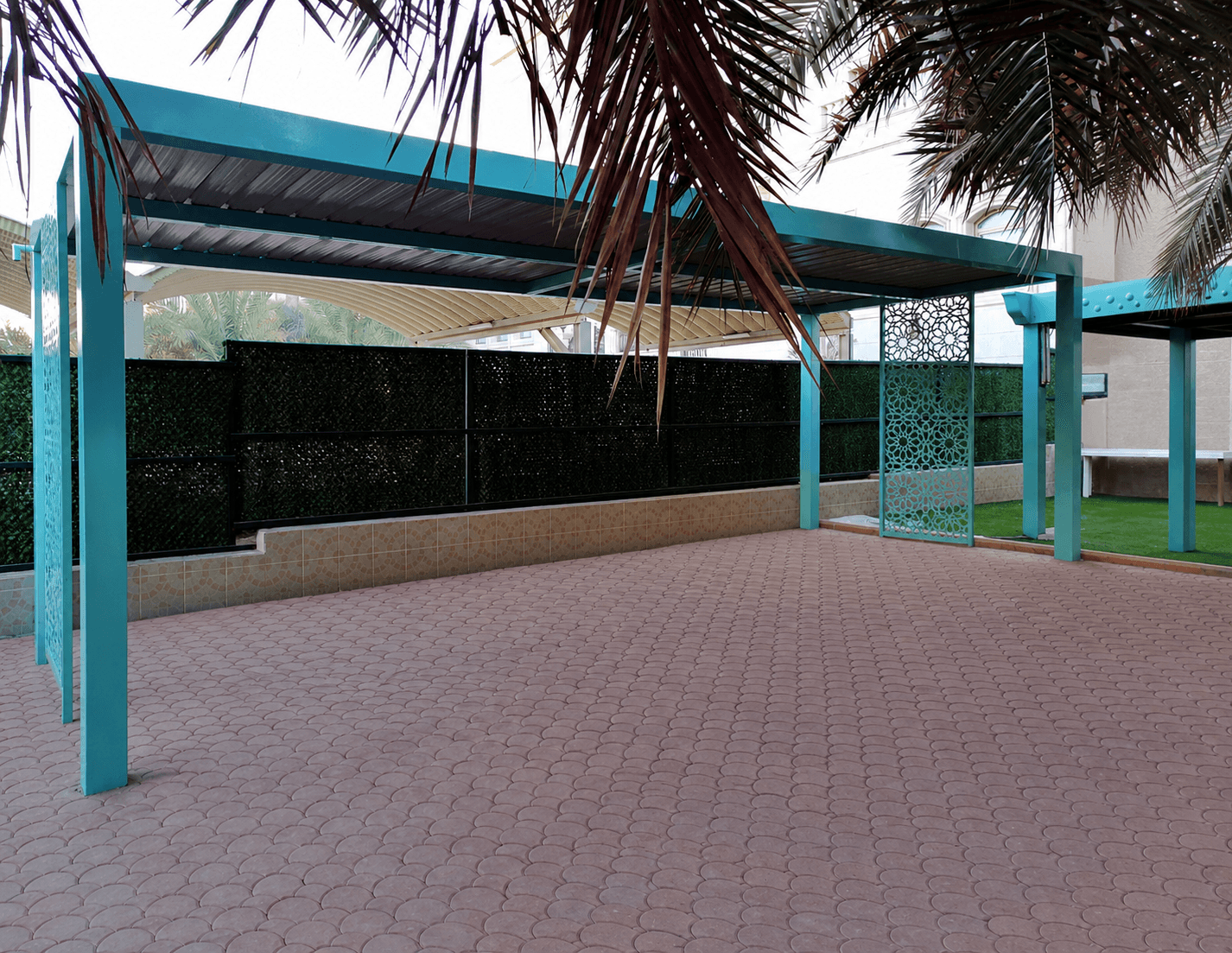
Polycarbonate and HDPE fabric roofing panels experience uplift and lateral pressure during gusts. Panels fixed with inadequate fastener counts or overspanned between purlins can crack, detach, or deform. The fix is correct panel thickness, adequate purlin spacing, and snap-lock or screw-fixed connections with UV-grade washers. View storm-resistant shade structure projects built to Kuwait’s wind load requirements.
Paint and Surface Coating Abrasion
Fine sand particles at 80 km/h gusts act as a fine-grade abrasive on powder-coat paint surfaces. Thin paint (under 20 microns) shows micro-abrasion visible as dulling and surface roughening within two to three shamal seasons. Proper 30-micron powder-coat takes significantly longer to show abrasion effects and resists the process more effectively. Annual inspection after shamal season is essential for catch-and-treat before rust appears at abraded points.
Sand Accumulation in Gutters and Joints
Every major shamal deposits measurable sand quantities inside pergola gutters, purlin channels, and polycarbonate panel cells. Accumulated sand retains moisture from morning dew and Kuwait’s winter rain, accelerating corrosion in any steel element it contacts. Annual post-shamal gutter cleaning is a maintenance requirement for any Kuwait shade structure, not optional upkeep.
Fastener Loosening Under Dynamic Loading
Shamal gusts create repetitive dynamic loading cycles on shade structure frames. Fasteners that are correctly torqued on installation can progressively loosen under repeated gust-and-rest cycles over several seasons. An annual bolt torque inspection is the simple maintenance procedure that prevents this minor maintenance issue from becoming a structural safety concern.
How to Protect Outdoor Structures from Kuwait Sandstorms — Step by Step
- Specify Structures to Kuwait’s Wind Load Code from the Start: Any permanent outdoor structure in Kuwait should be designed to a minimum wind speed of 110–120 km/h for gust loading. This is the engineering standard that separates structures that survive shamal events from those that do not.
- Use Welded Joints Rather Than Bolted Frame Connections: Welded connections at frame joints are significantly more resistant to progressive loosening under dynamic shamal loading than bolted connections. For any permanent structure, welded steel construction is the correct specification for Kuwait conditions.
- Seal All Panel Edges and Channel Openings: Polycarbonate panel ends should be fitted with aluminium U-channel end caps and UV-grade silicone sealant on all edges. This prevents sand infiltration into the twin-wall panel cells where it accumulates, retains moisture, and stresses the panel structure over time.
- Schedule Post-Shamal Season Inspections Every April: After Kuwait’s main spring shamal period ends in April, inspect every shade structure for abraded paint, loose bolts, cracked panel edges, gutter accumulation, and sealant condition. Early intervention on minor issues prevents compounding deterioration through the subsequent summer.
- Install Gutter Covers or Screen Mesh on All Gutter Runs: Gutter covers reduce the volume of sand entering the drainage system while still allowing rainwater to flow. They significantly reduce the frequency of required gutter cleaning and prevent the gutter overflow and pooling that damages anchor pad concrete over time.
- Anchor Structures Deeper Than the Standard for Kuwait’s Sandy Soil: Kuwait’s sandy topsoil provides lower bearing resistance than compacted subsoil. Anchor pads should reach a minimum of 600mm depth with proper concrete mixing — not dry-pour or sand-fill pad construction that degrades rapidly under wind-transferred loading.
Expert Tips for Sandstorm-Proofing Kuwait Outdoor Structures
Why Choose Haddad Muzallat for Sandstorm-Resistant Outdoor Structures?
Understanding how sandstorms affect outdoor structures in Kuwait is what separates structures that last from structures that fail.
- 20 years of post-shamal performance observation across every installed structure type in Kuwait
- Every structure designed to Kuwait wind load standards with documented engineering basis
- Welded frame construction standard — no bolted frame connections in permanent installations
- 30-micron powder-coat standard resistant to shamal abrasion for 10+ seasons
- Post-storm rapid assessment service via WhatsApp for urgent repair identification
- Structured annual maintenance contracts covering post-shamal inspection and minor repair
- 500+ structures standing through Kuwait’s most severe recent shamal seasons as performance proof

Comparison Table — Haddad Muzallat vs Typical Competitors
| Feature | Haddad Muzallat | Typical Competitor |
|---|---|---|
| Wind Load Design Standard | 110–120 km/h gust design | Unspecified, often under-designed |
| Frame Construction | Welded joints standard | Bolted connections common |
| Paint Thickness | 30+ microns powder-coat | 20 microns or less |
| Panel Edge Sealing | UV silicone + aluminium cap | Often unsealed |
| Anchor Depth | 600–800mm concrete anchors | Depth unspecified or shallow |
| Post-Storm Service | WhatsApp response within 24h | Slow or no response |
| Maintenance Contract | Annual structured programme | Not offered |
| Kuwait Experience | 20 Years (since 2004) | 2–6 years |
| Fabrication | 100% in-house | Frequently subcontracted |
| Projects Completed | 500+ Kuwait structures | Under 100 typical |
Our Track Record Speaks for Itself
- ✅ 20 Years Through Kuwait’s Shamal Seasons: Every structure installed since 2004 has been observed through multiple spring shamal cycles — performance data informs every new design decision.
- ✅ 500+ Structures Built to Kuwait Wind Standards: Not one has been cited for structural failure due to under-specification in over two decades of operation.
- ✅ All Kuwait Governorates Covered: Al Asimah, Hawalli, Farwaniya, Mubarak Al-Kabeer, Ahmadi, and Jahra — every climate micro-zone in Kuwait served.
- ✅ Post-Storm Emergency Response Available: Same-day WhatsApp consultation for storm damage assessment available to all clients.
- ✅ Client-Requested Repeat Projects: The majority of repeat clients return specifically because their previous Haddad Muzallat structure survived Kuwait’s conditions without requiring remedial work.
External Reference: Public Authority for Applied Education and Training Kuwait (PAAET) — for construction and metalwork standards relevant to Kuwait’s wind load and climate-specific building requirements. Visit Kuwait for a wonderful tour.
Cost of Sandstorm-Resistant Structure Upgrades in Kuwait
Indicative pricing only. Actual costs depend on structure size, existing specification, and required remediation scope.
| Service | Estimated Cost (KWD) | Frequency |
|---|---|---|
| Post-Storm Inspection | 50–150 KWD | After major shamal events |
| Annual Maintenance Contract | 150–400 KWD/year | Annual |
| Panel Replacement (per m²) | 20–40 KWD/m² | As required |
| Paint Repair and Touch-Up | 80–250 KWD | Every 5–7 years |
Post-Sandstorm Inspection Process
- Visual Assessment: Full walkround inspection of all surfaces, panel edges, joints, and gutter profiles for damage, sand accumulation, and paint condition.
- Structural Check: Bolt torque tested at all base plate connections and cross-frame joints. Any loose fasteners re-torqued to specification.
- Panel and Seal Inspection: Polycarbonate panel edges, silicone seals, and gutter cover integrity checked and remediated where required.
- Report and Recommendation: Condition report issued to the client with any required repair recommendations, priority level, and cost estimate.
Materials That Resist Kuwait Sandstorm Damage
- Galvanised steel (2mm+): sacrificial zinc layer absorbs abrasion without exposing base steel
- 30-micron powder-coat: significantly thicker than standard, resisting sand abrasion for 10+ seasons
- UV-stabilised polycarbonate: harder surface than standard acrylic, more resistant to particle impact
- Aluminium U-channel end caps: seal panel cells against sand infiltration permanently
- UV-grade silicone sealant: maintains flexibility at Kuwait’s thermal extremes without cracking
- Gutter mesh covers: prevent sand accumulation without impeding drainage
Warranty and Sandstorm Maintenance Support
- Structural frame: 5-year warranty including post-storm damage assessment
- Powder-coat finish: 3-year warranty — normal shamal abrasion is covered under maintenance, not warranty claim
- Polycarbonate roofing: 10-year UV warranty; impact damage from debris is a maintenance matter
- Post-storm rapid response: available via WhatsApp +96597987672 within 24 hours
- Annual maintenance contract includes two post-shamal season inspections per year
- Emergency repair service for structurally compromised installations — priority response for existing clients
Search Intent: Sandstorm Damage and Protection Queries
People searching for how sandstorms affect outdoor structures in Kuwait are typically responding to storm damage they have already experienced, or planning ahead to prevent future damage. Both are valid starting points. For damage assessment on an existing structure or to specify a new one to Kuwait’s shamal standard, contact the team via the contact page or WhatsApp +96597987672 for a direct response.
Serving Kuwait Properties in All Sandstorm-Affected Areas
Sandstorm impact varies across Kuwait. Northern and western areas including Jahra, Sulaibiya, and Abdullah Al-Mubarak are most exposed to the north-northwest shamal wind corridor. Central areas including Farwaniya’s Khaitan, Omariya, and Firdous experience full shamal force with urban dust compound. Coastal zones in Salmiya, Fahaheel, and Fintas add salt-laden air to the abrasive dust challenge. Every regional variation is accounted for in the Haddad Muzallat specification process.
Frequently Asked Questions — How Sandstorms Affect Outdoor Structures in Kuwait
Q1: Can a Kuwait sandstorm collapse a shade structure?
A properly engineered shade structure built to Kuwait’s wind load standard (110–120 km/h gust design minimum) will not collapse in a typical shamal event. Structures that fail during sandstorms in Kuwait are almost always under-specified — thin steel, inadequate anchors, or bolted rather than welded frame connections. Post-storm collapse inspections consistently reveal that failed structures were not built to the wind load requirements Kuwait’s climate demands, rather than showing failures in well-specified installations.
Q2: How do sandstorms damage polycarbonate roofing?
Kuwait’s sandstorms damage polycarbonate through two mechanisms: particle impact abrasion on the surface, which causes micro-scratching that reduces optical clarity and UV performance over time, and sand infiltration into the twin-wall panel cells through unsealed edges. The second type of damage is more structurally significant — sand trapped inside the cell retains moisture and exerts internal pressure during thermal expansion. Properly sealed end caps and UV-grade silicone on all panel edges prevent the infiltration damage entirely.
Q3: How often does Kuwait experience significant sandstorms?
Kuwait typically experiences significant shamal wind events 8–15 times per year, concentrated in the March–May spring period and less frequently in autumn and winter. Major visibility-reducing dust storms (haboobs) occur 3–5 times annually on average. Wind gusts during major events regularly exceed 80 km/h, with the strongest events approaching 100–110 km/h. Every shade structure in Kuwait must be designed to withstand these conditions as a recurring engineering load case, not a rare exceptional event.
Q4: Should I remove fabric shade panels before a sandstorm?
For major shamal events with predicted gusts above 70 km/h, removing fabric shade panels (HDPE sail shades, fabric pergola infills) is strongly recommended if your structure allows it. Fabric presents significant wind resistance and transfers very high lateral loads to posts and anchor points. Polycarbonate and aluminium composite panels are rigid and can remain installed during all but the most extreme events. If forecast gusts exceed 100 km/h, all removable elements should be taken down until the storm passes.
Q5: What is the best maintenance routine after Kuwait’s shamal season?
After Kuwait’s main shamal season ends in late April, carry out the following inspection: hose all surfaces to remove abrasive sand particles, check and re-torque all visible bolts and base plate fasteners, clear gutter runs of accumulated sand and debris, inspect all panel edge seals and reseal with UV silicone where cracking or separation is visible, touch up any abraded or chipped powder-coat paint to prevent rust initiation, and check polycarbonate panel edges for cracking at fixing points. The full process takes 2–4 hours and prevents significant deterioration accumulating through the subsequent summer.
Contact Haddad Muzallat today — WhatsApp: +96597987672 | Get a Free Quote Online → Contact Us
Conclusion
Kuwait’s sandstorms are a predictable, recurring structural challenge — not an unpredictable natural disaster. Outdoor structures built to the correct wind load standard, with welded frames, deep anchors, sealed panels, and proper paint thickness, survive Kuwait’s shamal seasons without significant damage for 15–25 years. حداد مظلات الكويت has been engineering to this standard since 2004. For new structures or existing structure assessments, visit the About page or get in touch directly to discuss your requirements.